• Skip to main content
  • Skip to footer

USGG 100-Ton Master Captain Jeff Vegas

White Glove Captain Services

  • Home
  • Services
  • Passion
  • Testimonials
  • Commissary
  • Captain’s Blog
  • FAQs
  • Drop a Line

Safety

Mar 20 2026

In 2026, I Consider Starlink Mandatory Safety Equipment

There, I said it. In 2026, I consider Starlink mandatory safety equipment on any boat that leaves the harbor with real intentions of going somewhere.

Not a luxury.
Not a toy.
Not a “nice if you have room in the budget” add-on.

Mandatory.

Now before the old-school crowd gets all worked up, let me be clear: Starlink is not a substitute for seamanship. You still need judgment, weather sense, a VHF, proper safety gear, and the ability to not make stupid decisions just because you have internet. But if you can have reliable communication and weather data offshore and choose not to? At this point, that feels less salty and more stubborn.

Photo by George Bakos on Unsplash

“But We Used to Sail Without It”

Yep. We did. We also used to do a lot of things because we didn’t have better options. That doesn’t make those days romantic. It just makes them the old days. There’s a line in Captain Ron: “If it’s gonna happen, it’s gonna happen out there.” He’s insinuating that you don’t need to be prepared, you just need to go, and you’ll figure it out. But things do happen out there. Systems fail. Weather changes. Stuff breaks. People get hurt. Plans go sideways. And when they do, wouldn’t you rather be able to get updated weather, message someone ashore, troubleshoot a mechanical issue before it becomes a dangerous one, or reach the right person before a small problem turns into a real one? That’s not weakness, that’s good decision-making.
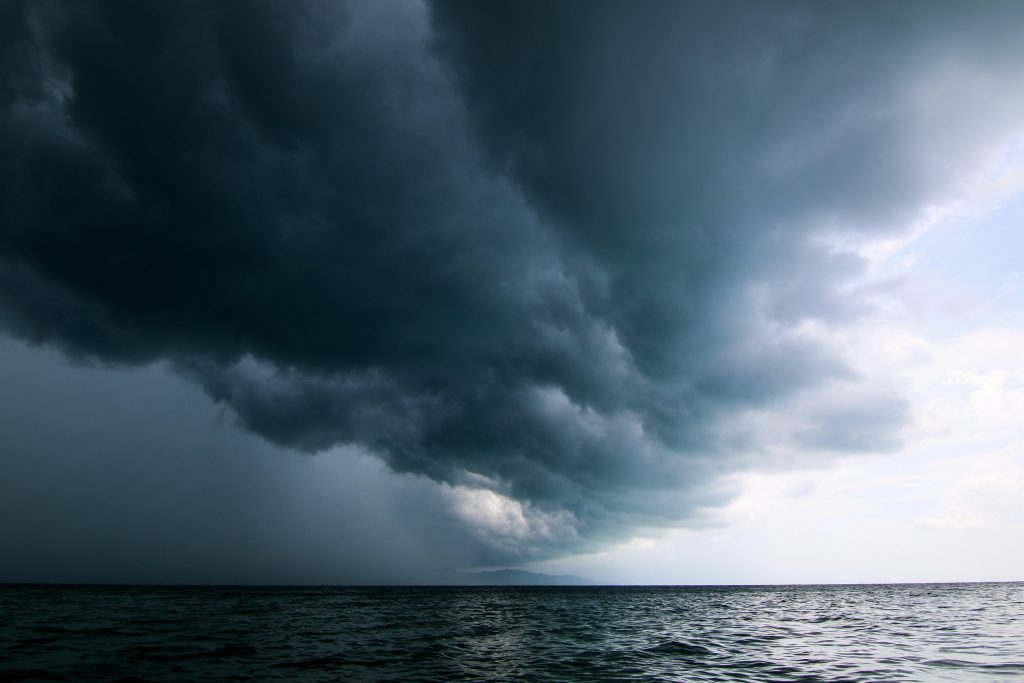
Photo by Daniel Lerman on Unsplash

Safety Isn’t Just About Surviving the Emergency

A lot of people think safety gear only counts if it helps after everything has already gone to hell. Life raft. EPIRB. Flares. Ditch bag. All important. But real safety also includes the stuff that helps you avoid the emergency in the first place. That’s where Starlink has earned its place. If I can pull updated weather, contact someone ashore, get technical help, coordinate with a marina, or simply keep worried family from thinking I’ve been swallowed by the sea, that’s safety equipment in my book.

My Opinion

Starlink doesn’t make you invincible. It doesn’t replace skill. It doesn’t mean you stop carrying backups or suddenly become Captain Prepared because you can check email in the middle of nowhere. But in 2026, leaving the dock without it for serious cruising or passagemaking feels a little like using a rotary phone because you prefer things “old school”. You can do it. I just think it’s a bad argument.
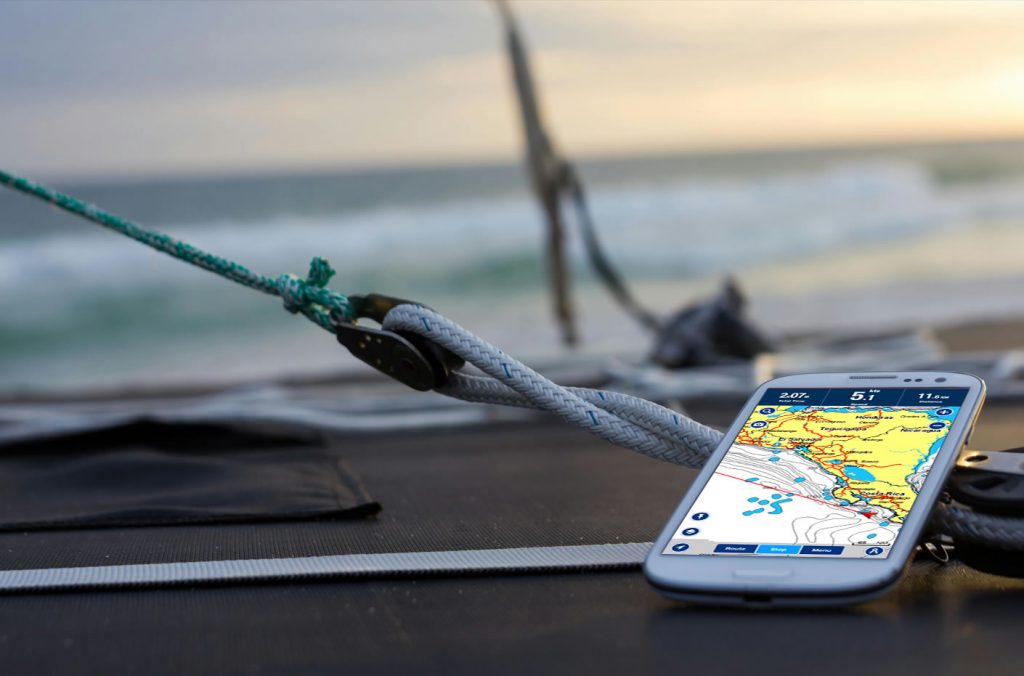
Photo by Pixabay from Pexels

Final Thoughts

Boating will always involve risk. That’s part of the deal. But if a piece of equipment can help you avoid bad weather, solve problems faster, communicate offshore, and reduce the odds of a small issue becoming a big one, I no longer see that as optional tech. I see it as safety gear. Mandatory? Legally, maybe not. Mandatory in the real-world, common-sense, I’d-like-to-stack-the-deck-in-my-favor sense? Absolutely!

Fair winds,
Captain Jeff Vegas
Watch video testimonials for Captain Jeff Vegas by clicking this link

P.S. If you’re outfitting a boat for cruising, passagemaking, or delivery work and want help thinking through the gear that actually matters, reach out. I’m always happy to help sailors make smarter, safer choices.
Written by ClassyCaptain · Categorized: Captain's bLog, Equipment, Safety

May 10 2024

You Wanna Boat Solo? How Wrong Could it Go?

First, what’s the difference between someone very experienced and someone barely experienced? The more experienced person recovers faster when they make a mistake (and they will still make mistakes).

The last time I ventured out solo on my sailboat was many years ago. To be fair, I’ve gained significantly more experience since then. Maybe you’re even more seasoned than I was back then or more experienced than I am now. Regardless, this incident perfectly highlights why the “buddy system” is a smart move.

Image by (Joenomias) Menno de Jong from Pixabay

Back then, I co-owned the boat, and one of our partnership rules was to hand it over to the other partners with the waste tanks emptied. There were two options for this task. I could have called the local pump-out service, which cost around $40. They’d swing by and take pump it out. However, for reasons I can’t recall—maybe I was tight on cash or just being frugal—I opted not to spend on the mobile service.

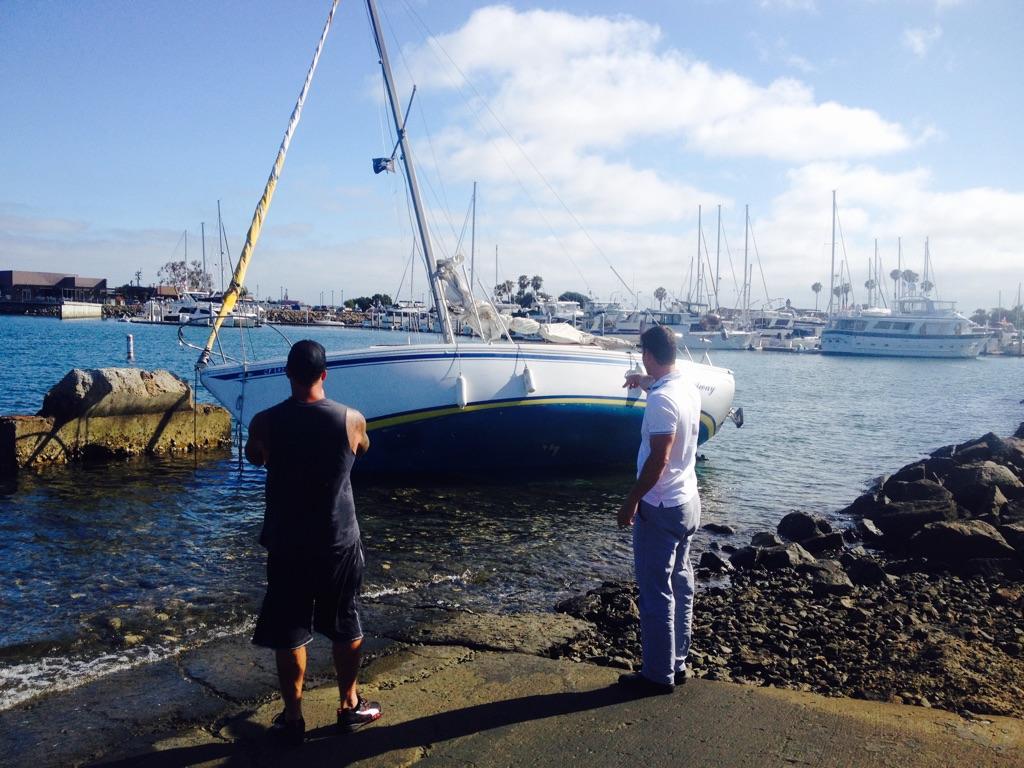
So, I fired up the motor and sailed past rows of boats to reach the pump-out dock conveniently located near the marina entrance. As I approached, the outboard motor on my 28-foot Columbia, suddenly quit. Unfortunately, I focused more on restarting the motor than on my surroundings and, before I knew it, I was dangerously close to the rocks and then, stranded on them.

Quickly reaching for my cell phone, I dialed the tow company I had a membership to, and they dispatched a boat. In the V berth, below I found a couple of oars and attempted to use one to push myself off the rocks. Unfortunately, luck was not on my side—the tide was receding, and I was wedged in. The tow boat arrived pretty quickly, but realizing the risk of causing further damage, they refused to pull me off the rocks. So, a short trip to simply empty out the waste tanks turned into an unexpectedly crappy day (pun intended).

This is a real picture of my 28′ Columbia stuck on the rocks all those years ago.

Waiting for the tide to rise again to float the boat off the rocks became my only option. The boat sustained some damage, around two or four thousand dollars’ worth.

Anyway, had I just had another person aboard—someone not necessarily a skilled sailor but with some upper body strength—who could’ve followed my instructions while I wrestled with the motor, we could have easily avoided the rocky predicament.

In retrospect, that ill-fated solo trip stands out not just as a lesson in the intricacies of boat ownership but as a vivid reminder of the invaluable role a companion can play on the water. The mishap during a routine task underscored the significance of having an extra set of hands, eyes, and strength on board. As sailors, we are not just captains of our vessels but custodians of shared experiences. This misadventure, albeit inconvenient and costly, instilled a lasting appreciation for the communal nature of maritime pursuits. Whether novice or seasoned sailor, the story serves as a beacon, emphasizing the importance of camaraderie and teamwork in navigating the unpredictable tides of seafaring adventures.

I literally have not shoved off solo since that day, and I hope you won’t either.
Fair Winds
Captain Jeff Vegas
Watch video testimonials for Captain Jeff Vegas by clicking this link

Written by ClassyCaptain · Categorized: Captain's bLog, Safety

Apr 26 2024

Sailors Should Understand Reefing: Smooth Sailing in Rough Winds!

Sailing is a thrilling adventure, but as wind speeds increase, your vessel gets overpowered. That’s when it becomes crucial to manage your sails effectively in order to keep the boat and your crew safe. Reefing is the term used to refer to reduce sail area for strong winds. In this article I’ll layout what you need to know about reefing, including when to reef, how to do it, common mistakes to avoid, and tips for reefing on a catamaran or trimaran.

What is Reefing?

Reefing is the process of reducing the area of a sail in response to increasing wind speeds. By reefing, sailors can maintain control of the boat and prevent the sails from overpowering the vessel.

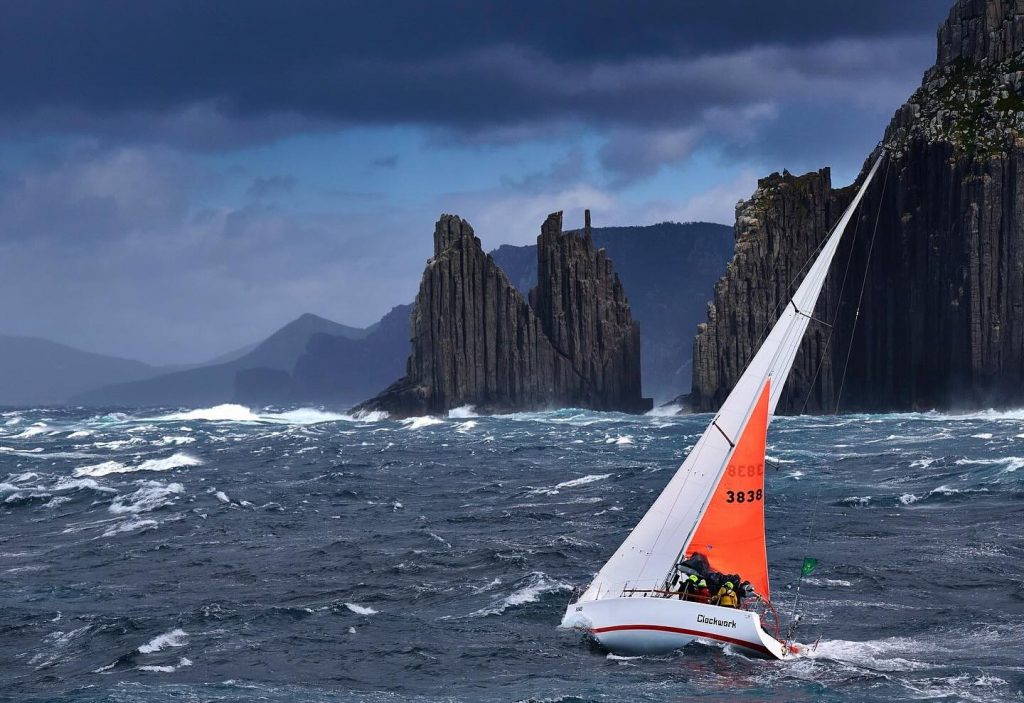
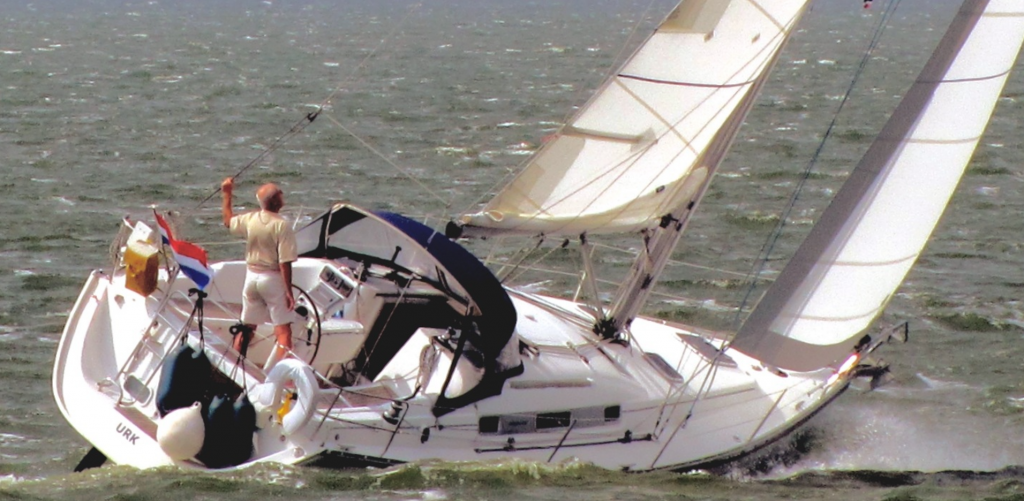
This sailboat is heeled over quite a bit.

When to Reef

I don’t know about you but I enjoy it when we are heeled over on a monohull, however, the truth is that the boat is less efficient when it’s heavily heeled, and your rigging is under extra strain, which can lead to costly problems. Excessive heeling can also be uncomfortable for your passengers, possibly inducing seasickness. If your boat is heeling excessively, it’s a sign that you probably should reef.
If you are experiencing “weather helm” (it’s challenging to control the wheel or tiller and/or keep your boat on course), reefing can improve control.

As a general rule, it’s a good idea to reef when the wind reaches around 15-20 knots, depending on your boat’s size and design, and modern boats will often have specific manufacturer recommendations about when to reef. You’ll want to be familiar with these recommendations for catamarans and trimarans as they will not heel nearly as much as a monohull, so you can unknowingly put extra strain on your sailboat.

How to Reef with typical sails (sails that raise/lower as opposed to furling)

1. Prepare the Boat: Ensure all crew members are wearing safety gear and are prepared for the maneuver. You may want to heave to if you are unfamiliar with the reefing system you are working with.
2. Lower the Sail: Ease the halyard to lower the sail just a little lower than the desired reefing point.
3. Secure the Reef Points: Attach the reefing lines to the sail at the designated reef points and tighten them to secure the sail. It should be noted that there are multiple ways reefs can be secured and it is important to understand how the reefing system works on any boat you are going to be on, before you shove off. If wind predictions show that you are likely to need to reef, it is better to do it at the dock in most cases.
4. Raise the Sail: Hoist the sail back up, ensuring it is properly tensioned and secured.

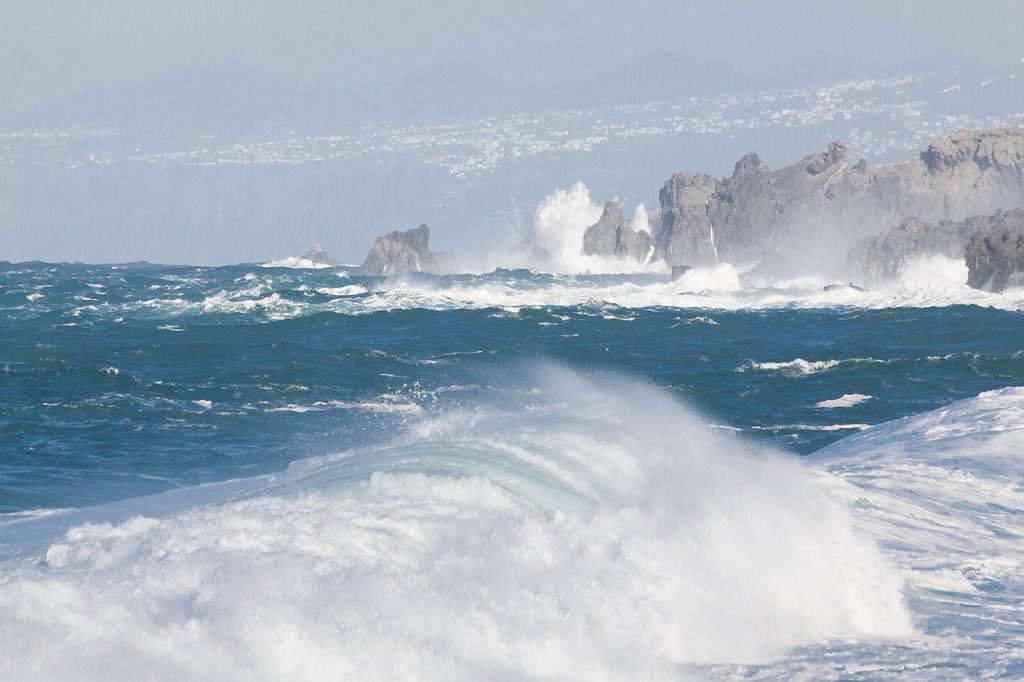
High winds means it’s probably time to reef your sails.                                                                                                         Image by Stefan Schweihofer from Pixabay

How to Reef with furled sails

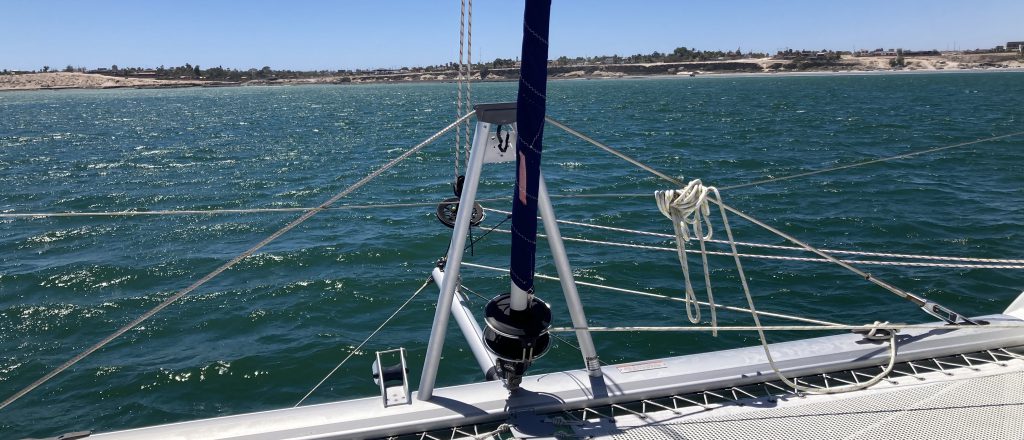
Some sails will have marks on the sail showing recommended reef points. This is most common on head sails (jib or genoa), but I have seen these on mainsails that furl. These can be a vertical line or large colored dots.

The vertical red fabric on the furled sail is a reef point.

How to Know When to Reef a Catamaran or Trimaran

• Sail Area: Catamarans and trimarans typically have a larger sail area relative to their size compared to monohull boats. As a result, they may need to be reefed earlier in higher wind speeds.
• Windward Performance: If your catamaran or trimaran is struggling to maintain a course into the wind, it may be time to reef to reduce sail area and improve windward performance.

Common Mistakes to Avoid

• Waiting Too Long: Reefing early is better than waiting until it’s too late. It’s easier to shake out a reef than to reef in a hurry.
• Improperly Securing Reef Points: Ensure that the reefing lines are properly attached and tensioned to avoid flapping sails or damage.
• Over- or Under-Reefing: Follow the guidelines for reefing based on wind conditions. Under-reefing can lead to excessive heeling and strain on the vessel, while over-reefing can reduce sail efficiency.

Reefing in Different Conditions

• Heavy Weather: In strong winds and rough seas, it’s essential to reef early and often to maintain control and prevent damage to the sails and rigging.
• Light Winds: Even in light winds, it may be necessary to reef to prevent excessive heeling and maintain a comfortable sailing experience.

Maintenance and Care

Regularly inspect your reefing gear for wear and tear. Clean and lubricate the reefing lines and hardware to ensure smooth operation when reefing is required.

Mastering the art of reefing is essential for any sailor looking to sail safely and comfortably in varying wind conditions. By knowing when to reef, how to do it, and common mistakes to avoid, you can ensure that you’re always prepared to handle whatever the wind and sea throw your way.

Fair Winds
Captain Jeff Vegas
Watch video testimonials for Captain Jeff Vegas by clicking this link

Written by ClassyCaptain · Categorized: Safety, Tips and Tricks

Apr 21 2023

If You Don’t Know the Right-of-Way Rules for Sailing, Here’s How You Can Still Stay Safe.

When you operate a sailboat, just like when you drive a car, it’s important to know who has the right-of-way under different circumstances. There are way more rules than I am going to cover here because this blog is geared toward the casual boater, but I will go through some of the basics, so you can be safe until you learn all of the rules.

First of all, try to remember that reasonably speaking the vessel with the least maneuverability in any situation, pretty much has the right-of-way, and the vessel with the most maneuverability should avoid the other because it can.

A boat being powered by sail almost always has the right of way over a boat being propelled by an engine (including if the boat being propelled by an engine has sails). The logic is simple; wind direction and speed limit how a sail-powered boat can maneuver, and a boat being pushed by a motor does not have those same restrictions. There are a couple of notable exceptions. Really large power boats do not have the same ability to maneuver as smaller power boats. I have sailed many enjoyable hours in San Diego Harbor, where large Naval and commercial ships are a part of every day boating life. Those large ships are not going to be able to alter course or speed in time to avoid a small sailboat, so always stay out of their way.

Photo Credit: Me

If any boat is honking a horn at you, there is a very good chance they don’t believe they can safely avoid you… maybe they are a large ship, or maybe they are similar to your size, but their engine died or their steering is not operating properly. If you hear a horn, instead of yelling at the other boat, assess the situations to see if they may be directing the horn at you, and if so, take evasive action immediately to avoid a collision.

Next, anytime you are overtaking (passing from behind) another boat, the boat overtaking must stay clear of the boat they are passing. Clearly you have (or are using) more power than them, so you should stay a safe distance.

If two powerboats are about to meet in a head-on (or near head-on situation), both boats are required to adjust their coarse to starboard (for you casual boaters who are not clear on these terms yet port and left both have a ‘t’ at the end and are both four letters, so they are the same), however, if two sailboats are about to meet head-on, the boat with the wind coming over her starboard (right) side should not alter course or speed; it is the stand-on vessel and the other boat should give way (making it the give-way vessel). To help you remember this, think “right is right” so that if the wind is on the right side of your sailboat, you have the right-of-way. See this is a case where both vessels theoretically could be evenly matched in maneuverability, so someone had to be the winner, like when two cars arrive at a 4-way stop at the same time.

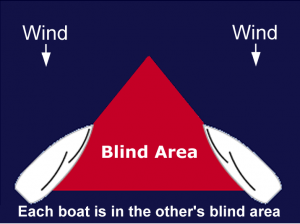
Your sails sometimes reduce the vision of the person at the helm (wheel or tiller). Keep this in mind as well when determining whether you will give-way or stand-on. It does not change who actually has the right of way, but it could save you from having a problem. If you are operating a sailboat and the boat has blind spots because of sails, make sure you have someone responsible in a location on the boat where they will help you see what might be hiding there and remember that if you are in their blind spot, even if you have the right-of-way, you may need to adjust because they might not see you.

Keep a portable airhorn handy because you, alone, may not be able to avoid a collision, and you may need to alert the other vessel of this.

There may be times when you could barely change course and still feel confident that you will avoid the stand-on vessel, but they may not notice a small course change, so for the comfort of the other skipper and all on board that boat, make a substantial course change; one that makes it obvious to them that you are doing they right thing, so that they can relax and enjoy more of their day out on the water.

Of course, whether in a car or on the water, never insist on the right of way to your detriment. It is everyone’s responsibility to avoid a collision and if there is a collision on the water, the insurance companies usually state that all vessels involved had at least some share of the blame. Plus if the other guy is an idiot, it shouldn’t ruin your whole day (or several weeks waiting for your vessel to be repaired). Finally, I implore you to please really know the rules before you take the helm of any sailboat.
Fair Winds
Captain Jeff Vegas

Written by ClassyCaptain · Categorized: Captain's bLog, Safety

Apr 14 2023

The Love Language of Sailing

A few days ago I was giving private lessons aboard someone’s brand-new sailboat. Their insurance company required more training for both owners before they would allow them to take it out without a licensed captain. One of the owners, John was there with his girlfriend Susan, and she said to him, “Why don’t you tell Captain Jeff about our love language?”. Of course, my immediate thought was “is this going to be TMI?” (Too Much Information)

Photo by Jonathan Borba

The Problem:

So he started off by telling me that they have been together for about 10 years and they have been sailing together from the beginning. For many years, she would mention potential collisions with something like, “There’s a sailboat off the starboard bow at 1 o’clock” and he would often snap at her with some retort like “I KNOW” or “DO YOU THINK I’M BLIND?”.

This went on for awhile, and not surprisingly, one day he almost collided with another vessel and he snapped at her again “DID YOU SEE THAT BOAT COMING?”. She replied calmly, “yes, I saw it”, and he yelled “WELL THEN, WHY DIDN’T YOU WARN ME ABOUT IT?” and she calmly said, “you’re not blind”. IT was at that moment he realized how his demeanor was not only a poor way to stay safe on his vessel, but it was not helping his relationship either, so he came up with a new plan.

Photo by Andrea Piacquadio


The First Part of the Solution:

Whenever she would point out a buoy, boat or other obstacle he might want to notice, his response would be “Roger that”. If you don’t know, “copy” or “copy that” is a term used in business and military settings to indicate that the speaker has heard and understood the previous statement. “Roger” or “Roger that” is also a term used in business and military settings, but it is supposed to indicate that the speaker agrees with the previous statement.

The semantics aren’t important, what is important is that since implementing their new communication protocol, not only are they safer, but sailing has returned to the wonderful experience it always had been, and they say their relationship is stronger than ever, because it is not strained when they are relaxing while sailing. After realizing how it changed the dynamic of their relationship while sailing, they dubbed it their “love language of sailing”.

The Second Part of the Solution:

Then they decided to take their “love language” one step further. They bought walkie-talkie headsets to use when they are too far to speak to each other without yelling. Let’s say they are trying to dock; she is on the bow and he is at the helm; the only way to communicate without the headsets is to yell. They decided that there is no nice way to yell. Even if you are trying to be helpful, but the other person is so far away they can’t hear your normal volume, the yelling could be misconstrued, so now they talk calmly into their headsets, at a normal voice, and their relationship is not strained during that process.

Image by AllClear55

If you have read my statement on the home page with the heading “You’ve heard the term ‘salty’ as it refers to someone’s demeanor, right?” then you know that their old way of being is something I experience all too often with skippers and I have never liked it. When I am at the helm of a boat, I share with everyone on board, “unlike many skippers, I will never get upset if you point out an obstacle of any sort that you think there is any chance I have not seen. I would rather have you tell me about something I already saw, than have you assume I didn’t see it”, and I have always replied with two words as well, “thank you”.

The Truth

Accidents happen on the water for all kinds of reasons, and too often, it boils down to the skipper did not see the obstacle early enough to avoid it. If you’re the salty skipper that yells at people who are trying to keep you and your vessel out of harm’s way, I suggest you adopt the “love language of sailing”.
Roger that?

Fair Winds
Captain Jeff Vegas

Written by ClassyCaptain · Categorized: Captain's bLog, Equipment, Safety, Tips and Tricks

  • Go to page 1
  • Go to page 2
  • Go to Next Page »

Footer


LogoTerms of Use  |  Privacy Policy


Copyright © 2026 ·Top Hat and Sails